.png)
NO MORE (NICHT MEHR, NEBĖRA) Searching for Spirituality in the Former St. Marien Church
Tomas Lagūnavičius
St. Marien, Essen, Germany, August 14, 2026, 2:13 PM
Manifesta 16 Ruhr — “This is not a Church”
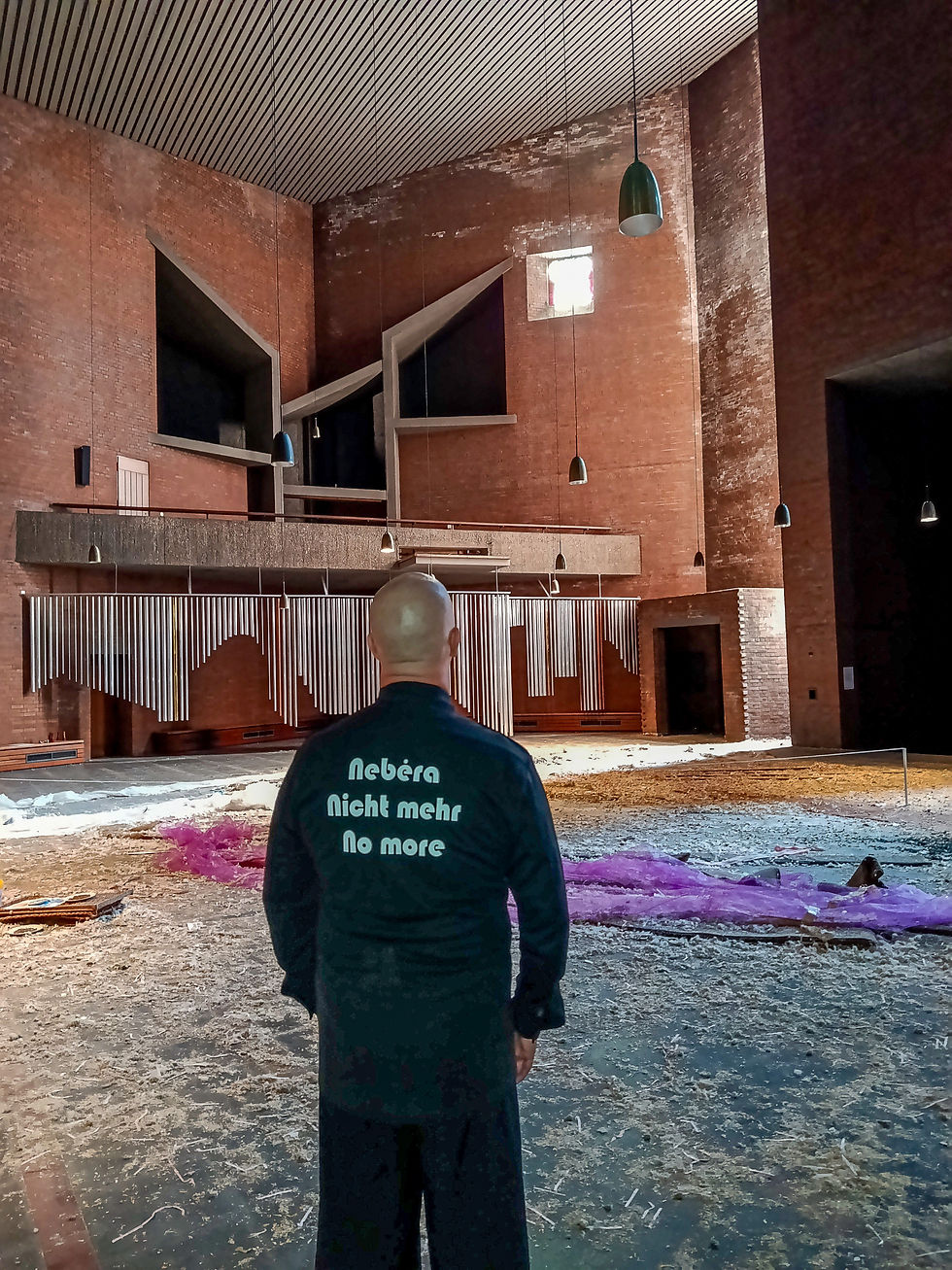
At 2:13 PM on August 14, 2026, multidisciplinary artist Tomas Lagūnavičius presented the minimalist conceptual performance “NO MORE (NICHT MEHR, NEBĖRA)” in the former St. Marien Church in Essen. The artist appeared in the space wearing a T-shirt bearing the same phrase in three languages: NEBĖRA / NICHT MEHR / NO MORE.
This simple inscription becomes the central concept of the work: what disappears when a church closes? Does only the religious institution disappear, or is spirituality also lost along with it?
The history of St. Marien gives particular weight to this question. The first church on the site was built in 1895–1896 but was destroyed during World War II in 1944. The present-day St. Marien was built between 1961 and 1963 according to a design by architect Hans Schilling and consecrated in 1963. In 2019, the church was deconsecrated and ceased to function as a Catholic place of worship. In 2026, it became one of the artistic venues of Manifesta 16 Ruhr.
St. Marien therefore exists today between two states: it is no longer a functioning church, yet it is not simply a neutral building either. The memory of its former religious life remains embedded in its architecture, stained-glass windows, spatial qualities, and silence.
It is precisely this liminal state that Lagūnavičius’s performance explores.
“NO MORE” is not simply a negation. The German NICHT MEHR points particularly clearly to a rupture in time: something existed, but no longer does. The inscription therefore speaks simultaneously of the past, loss, and memory.
During the performance, the artist’s body becomes a temporary vessel for this memory. There is no longer an altar, liturgy, or priest — only a human being and a question. The artist does not claim that God is gone, nor does he declare that spirituality has disappeared. Instead, he creates a situation in which the viewer must ask:
What remains spiritual in a former church?
Perhaps the architecture remains.
Perhaps memory.
Perhaps silence.
Perhaps human experience.
Or perhaps the question itself becomes a new form of spirituality.
From this perspective, “NO MORE” is less a performance about the end of religion than about the transformation of the sacred. When a church closes, spirituality does not necessarily disappear — it may move from ritual into memory, from institution into individual experience, from faith into questioning.
It is particularly significant that the performance took place in the context of Manifesta 16 Ruhr, whose central theme is “This is not a Church.” The former church becomes a space for contemporary art, yet Lagūnavičius asks an even more radical question: if it is no longer a church, does that automatically mean it is no longer sacred?
The performance offers no answer.
It leaves only three words:
NEBĖRA.
NICHT MEHR.
NO MORE.


Comments