.png)
INVISIBLE (보이지 않는, NEMATOMAS): The Philosophy of the Gaze, Invisibility, and Being
Tomas Lagūnavičius
July 4, 2026, 1:57 PM
Leeum Museum of Art, Seoul, South Korea
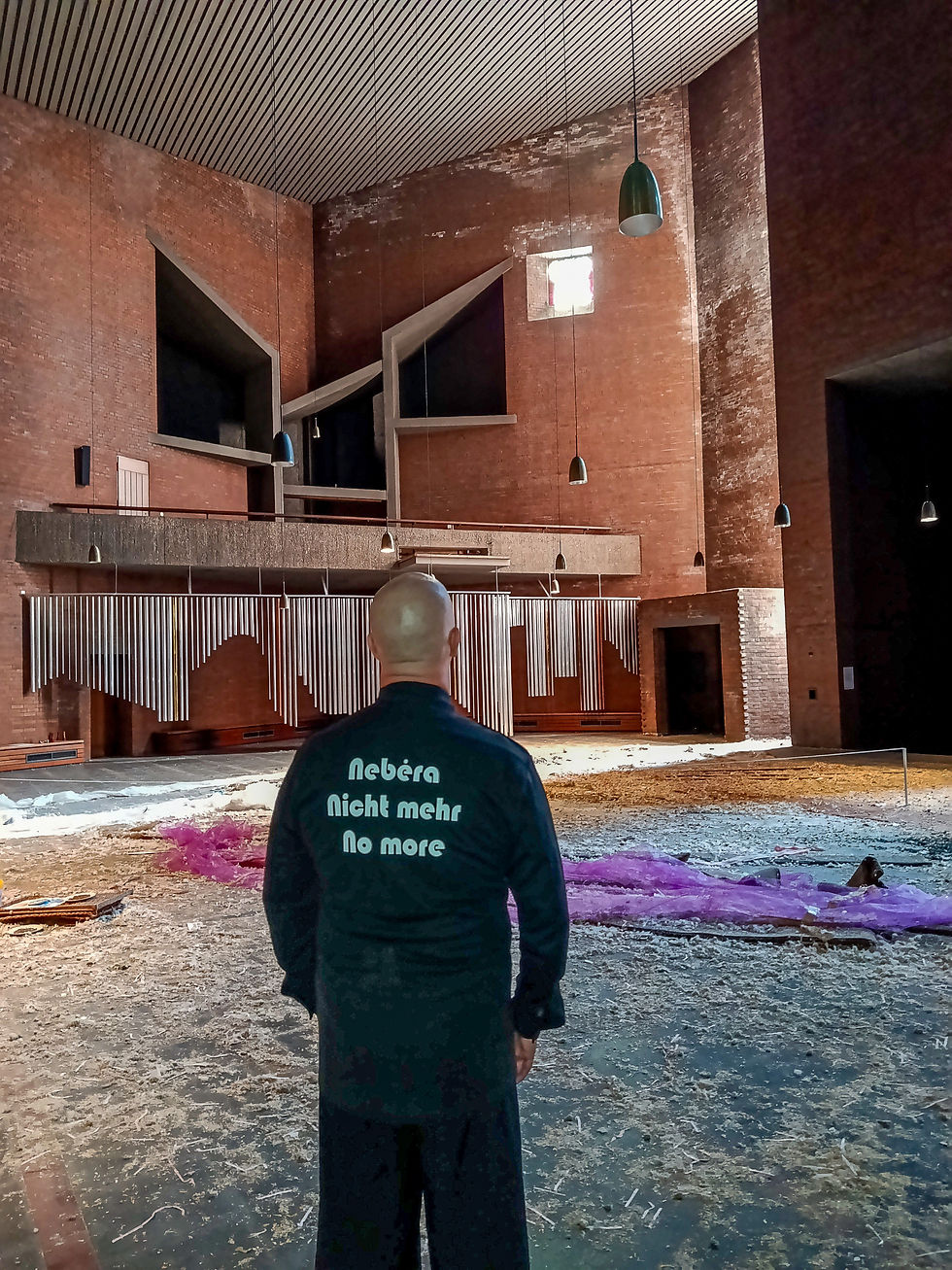
At 1:57 PM on July 4, 2026, multidisciplinary artist Tomas Lagūnavičius performed the minimalist conceptual performance INVISIBLE (보이지 않는, NEMATOMAS) at the Leeum Museum of Art in Seoul. This site-specific performance transforms the artist’s body not into a means of display, but into a means of dissolving into the surrounding environment. The central task of the performance was to become invisible: to merge with the flow of museum visitors, move among them, observe their behaviour, and follow their trajectories in much the same way as they themselves observe the works of traditional Korean art displayed in the museum.
The performance took place in Museum 1 of the Leeum Museum of Art, which houses traditional and ancient Korean art. This part of the museum was designed by Swiss architect Mario Botta. The architectural structure he created is not a neutral backdrop: it actively shapes the visitor’s movement, gaze, and relationship with the objects on display. The museum becomes a space in which certain objects are officially designated to be seen, while the human being generally remains in the position of the viewer.
It is precisely this conventional hierarchy that Lagūnavičius reverses.
In a museum, there is usually a simple structure:
visitor → artwork.
INVISIBLE transforms it into:
artist → visitor.
The person who has come to look at art becomes an object of observation. Most importantly, however, they are not necessarily aware of it. The artist does not announce his presence, attempt to attract attention, or perform a demonstrative gesture. He simply exists among other people and observes.
The work therefore emerges not from an external spectacle, but from the relationship of looking.
At the philosophical core of the performance lies the problem of invisibility. What does it mean to be invisible? Does invisibility mean that a person is absent? Can someone be physically visible yet socially invisible? Is it possible to be among many people and still remain unnoticed?
Lagūnavičius understands invisibility not as physical disappearance but as a social and phenomenological condition. The artist is present in the space, yet attempts not to acquire any special status within it. His body becomes almost indistinguishable in status from the bodies of other visitors, the museum architecture, or the movement taking place among the exhibits.
Yet a paradox emerges: in order to become invisible, the artist must observe with heightened awareness.
He sees others, yet does not wish to be seen himself.
The performance therefore raises a fundamental question:
Who watches the observer?
This question relates to Michel Foucault’s analyses of surveillance, visibility, and power. Observation is not merely an optical process. The person who observes occupies a particular position in relation to the other. INVISIBLE, however, destabilises this position: the observer cannot be certain that he himself is not being observed.
A particular paradox of invisibility emerges:
I am watching you. You do not know that I am watching you. Yet I cannot know whether someone is watching me.
In this way, the performance creates a persistent epistemological uncertainty. A person can never be entirely certain of their position within a system of looking.
This situation recalls Jean-Paul Sartre’s concept of the “gaze.” Another person can turn me into an object simply through their gaze. I experience myself not only as a subject but also as a potential object within another person’s consciousness. INVISIBLE turns this relationship into the primary material of the performance.
The visitor comes to the museum to look.
Yet the visitor may also be looked at.
The visitor believes themselves to be the subject.
Yet becomes the object.
The visitor believes they are observing an artwork.
Yet their own behaviour becomes part of the artwork.
The performance therefore raises not only the question “Is someone watching us?”, but also a deeper one:
“Can we ever truly know how we exist in another person’s gaze?”
Mario Botta’s architecture is also significant in this context. The museum space preserves objects of traditional Korean art whose cultural and historical value has been institutionalised. An object becomes a museum object because it is granted a particular status. It is removed from everyday life, framed, illuminated, and preserved.
The human being in the museum occupies the opposite position.
They are not preserved as an exhibit.
They come and go.
Their presence is temporary.
Their movement is fleeting.
Their gaze passes.
This contrast gives INVISIBLE an existential dimension. Why do we preserve objects for centuries while remaining unable to preserve human presence? Why can a museum preserve an artwork but not a person’s gaze, movement, or a particular moment of their being?
The performance therefore also becomes an exploration of time, memory, and transience.
At 1:57 PM on July 4, 2026, a particular situation existed. The artist occupied a particular space. Visitors moved along particular trajectories. Gazes met or failed to meet. A few minutes later, that situation had already ceased to exist.
Yet this very ephemerality is an essential part of the performance.
The museum preserves the past.
The performance exists in the present.
The museum seeks to preserve.
The performance allows things to disappear.
INVISIBLE can therefore be understood as an encounter between museum memory and human transience.
Another important aspect of the performance is the question of human significance.
Are we interesting to anyone?
At first glance, this question appears simple, yet it is profoundly existential. A person wants to be noticed, while at the same time wanting the right to remain unnoticed. We want to matter, yet do not want to be constantly observed. We seek recognition while simultaneously desiring privacy.
Invisibility can therefore signify two opposing states:
freedom and loneliness.
To be invisible is to be free from the judgement of others.
Yet it may also mean that no one notices your existence.
Lagūnavičius’s performance does not choose between these interpretations. Instead, it preserves the tension between them.
From this perspective, INVISIBLE can be understood as a perceptual and post-conceptual performance in which the primary artistic material is not an object but a relationship. The artist creates no additional artefact. Instead, he alters an already existing situation: the visitor’s relationship with other people and with their own gaze.
The work emerges between:
human and human,
observer and observed,
visible and invisible,
object and subject,
architecture and body,
art and everyday life.
INVISIBLE is therefore not merely a performance about becoming unnoticed.
It is a performance about the conditions of human existence.
It asks whether human existence depends upon being seen by someone. It asks whether we can ever be certain that no one is watching us. It asks whether another person’s gaze gives us significance or, conversely, turns us into an object.
Ultimately, Lagūnavičius’s performance reverses the very logic of looking within the museum.
The visitor looks at the artwork.
The artist looks at the visitor.
The visitor may be observed by another visitor.
The artist may be observed by the museum.
And the act of looking itself becomes the artwork.
The central proposition of INVISIBLE can therefore be formulated as follows:
We do not merely look at the world. We are constantly the objects of the world’s gaze, of other people’s gaze, and of our own gaze.
The performance does not answer the question of who is watching us.
Instead, it creates a situation in which we begin to ask:
Are those who watch us invisible?
Is someone watching us?
Are we interesting to anyone?
Is it possible to be completely invisible among other people?
And what remains of us when no one is looking at us?
It is precisely within this unanswered space that INVISIBLE exists — a performance in which the artist’s disappearance becomes a means of seeing the act of looking itself.


Comments